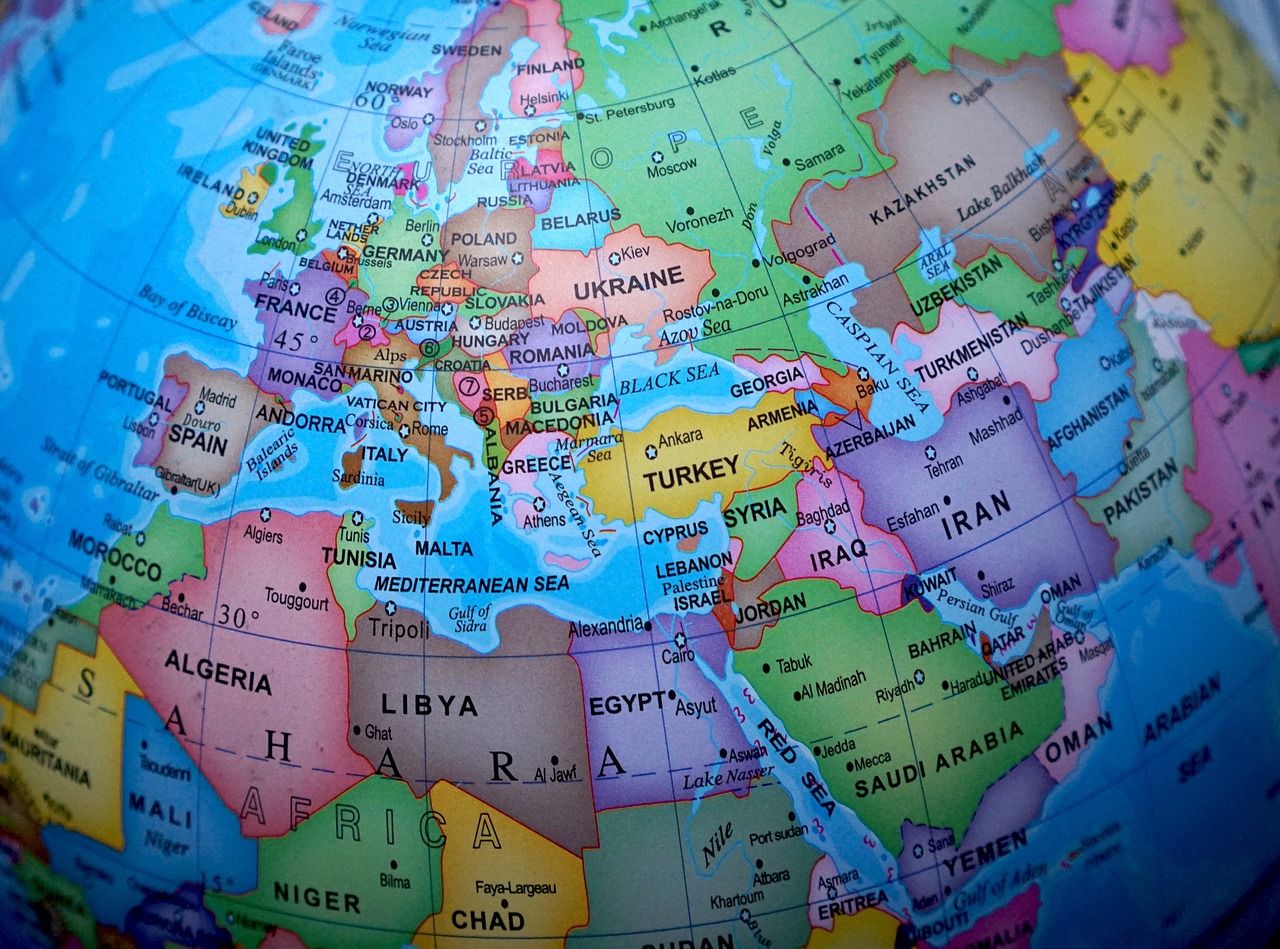
This months post is going to about a number of things: complexity, entanglement, and trying to make things better.
There will be some analogies as well as a sprinkle of similies (please mind the metaphors… they haven’t been fed in a while).
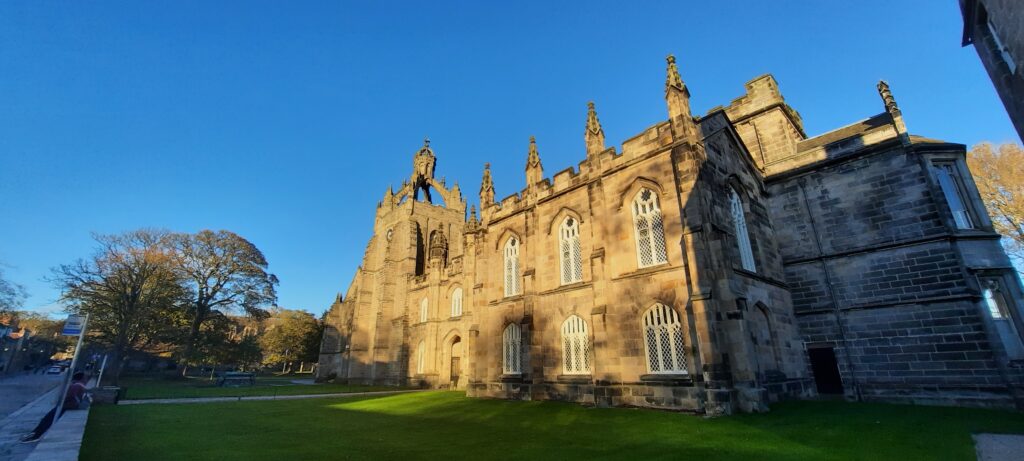
Last week I attended an early evening fireside chat at my alma mater, the University of Aberdeen, in the company of students, alumni, faculty and others with Sir John Curtice.
Sir John is, as per the event invitations own words:
“Professor of Politics at Strathclyde University, Senior Research Fellow at the National Centre for Social Research (NatCen), Co-Director of the Scottish Social Attitudes survey, President of the British Polling Council, and a highly regarded media commentator”
So somebody to whom, in my opinion, it would probably pay dividends to listen to.
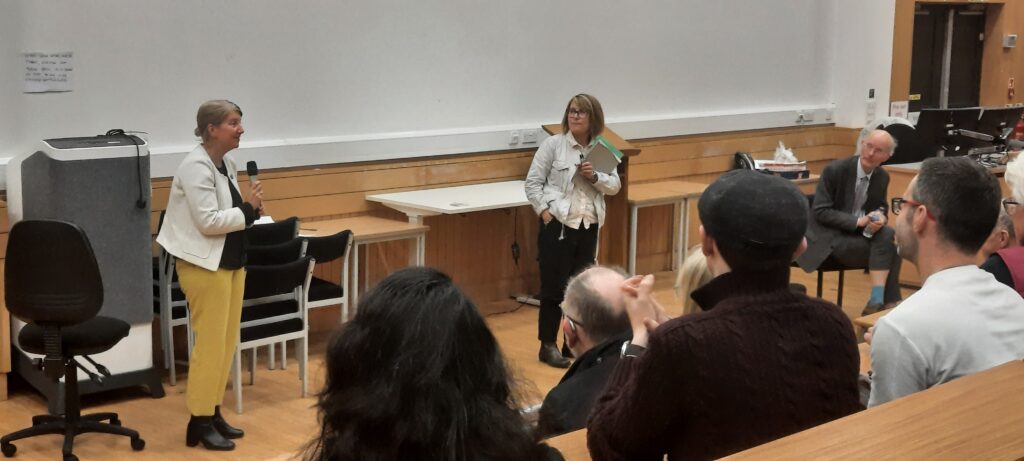
Professor Curtice sat in conversation with Dr Lynn Bennie from the U of A’s Department of Politics and International Relations.
Their discussion spanned regional and national politics as well as those of the international and the global.
The sorts of things which affect every person, business and organisation across various supply chains through trade agreements, regulations, customs, sanctions etc.
Fun fact: I filled in twelve (12) pages of my notebook with jottings, notes and other ideas that occurred to me as I listened in… this wasn’t just an enjoyable event I was there to work.
When you look at things through a political lens, taking stock of who, how and especially why, you can bring together threads of political systems, ideologies, legacy and ongoing decisions and outcomes (both seen and unforeseen).
From here it’s a short step to begin to understand just how little we are able to have any individual effect on the various forces which impact us.
This all perfectly normal, even if sometimes geopolitics is an absolute horror show.
Beyond politics, however, this post is fundamentally about systems.
Recognising and understanding systems is one way we try to break down the highly complex fabric of this world in which we exist.
It’s how you or I try to understand what was or is so we can make attempts to influence and control things as we would like them to be… at least as far as we are able.
Maybe.
Of course politics is one way to view things, but it is not the only way.
Professor Curtice discussed complexity as a natural consequence of bringing together people and politics.
He explained that however people try to build, maintain or improve political systems they always run the risk of unwittingly setting up what he called tripwires.
By this he meant things which catch people out, something unexpected over which they stumble.
They are the unintentional, often unseen consequences which can emerge from any system.
Note: We’re not talking about traps, ruses, ploys or pitfalls placed with purpose… although they can have their place within political science and strategy. Those are topics for another day!
This where the analogy of a rake came to me. Most people are unlikely to encounter a tripwire outside of a movie, a novel, theory or perhaps some sort of game.
Rakes, however, we are far more likely to encounter: in the garden, on a golf course, on a farm.
So let us have a chat about rakes. Metaphorical ones, but I digress…

A rake is designed for a purpose
A rake is manufactured
A rake is used with intent
It has utility
So far so good, right?
In the right hands in the right time and in the right place the right tool or implement helps us get things done.

Where things begin to get tricky is when complexity rears its inevitable head.
Perhaps we get distracted by something or someone. Or several somethings or someones.
We may forget to tidy away our tools and leave them lying around.
They may become missplaced, be left out in the weather, someone may tidy them away for us and not only place them somewhere other than where they ought to be stored but not tell us they have moved it at all.
We may entrust our tools to somebody else and they may become distracted.
Perhaps some opportunistic rogue comes along and wanders off with them.
Consider the following: lots of activity, lots of people, lots and lots and lots of rakes.
From agriculture to horticulture and much more besides how you treat your tools is important.
Note: One of the key inputs (and indeed outputs) for all organisations is information.
Don’t get me wrong: data and knowledge have their parts to play, but they are not the same even though they are intrinsically linked to one another.
When it comes to organisations systems are one of the tools in a leader or managers tool kit.
So, as a matter of fact, are data, information and knowledge… they’re also inputs and outputs, but they do have utility.
And of course there’s also the various processes, policies, procedures, plans, reporting methods, standards, work instructions, task lists and so forth.
These all necessarily rely on various inputs from stakeholders: customers and clients, suppliers, colleagues, peers, regulators and…
Oh look… it’s our friend complexity again.
If we’re not careful we’re going to find ourselves struggling to effectively manage our organsiations information requirements.
For example:
- Do we have everything in place to satisfy all stakeholder requirements (internal and external)?
- Are access and ownership clear in order to drive accountability?
- Are things accurate and up to date?
- What can be optimised, simplified or removed altogether?
This last one is all too easily overlooked:
- Do any of them contradict or conflict with one another?
Periodically effective organisations will ask themselves just how certain are they of all of the above and what else should be looked into?
Even if we succesfully manage our own portion of a complex system (or more likely a system of systems) we run the risk of stumbling over somebody elses rake.
We don’t mean to walk into them, other people probably didn’t deliberately set things up to be in our path to get underfoot but, well…
BONK!

I know it’s been said that if we’re not taking a rake to the face once in a while are we even trying?
Everyone makes mistakes, sure, and no system is perfect… but that’s not to say that we can’t keep aspiring towards driving continual improvement into our systems.
Information systems in support of (and to capture) decision making are no less important.
They drive and support accountability, responsibility and transparency.
These are key to managing risk through identifying amd satisfying issues of liability across your stakeholders.
As the conversation between Professor John Curtice and Dr Lynn Bennie went back and forth their dicussion turned towards the quadrant model of left wing versus right wing / liberalism versus conservativism as they relate to political and economic perspectives.
Quadrant modelling is a process we may use in an attempt to bring clarity to complexity.
Some readers may be familiar with Eisenhower matrices, PICK charts or the MoSCoW method approaches.
These can be useful for supporting decision making such as prioritising projects or resource allocation.
This includes information.
Such models are tools available to decision makers to aid analysis and support decision making against a backdrop of complex, dynamic forces and competing priorities in an imperfectly understood world.
Since we can anticipate complexity we can take purposeful steps towards preventing bottlenecks, decision paralysis, deadlock and other forms of bureacratic or systemic inertia.
Equally if we do encounter it, whether as an emergent issue or if we find ourselves in a new environment, we understand that we can do something constructive about it.
Professor Curtice discussed the impacts of globalisation, how Brexit has accelerated certain economic outcomes (and aren’t we feeling those these days?) and how the loss of confidence in political leadership affects almost every facet of the economic entanglement that makes up practically everything we face.
Here’s something fun to think about: we are not in control of most things most of the time.
Global, regional, national and local economies? The interactions of state and non-state actors in the field of geopolitics? Dispersed supply chains around the world? Other stakeholders, peers and competitors? Their systems and processes?
Nope.
At best we may have some modest influence and even then only briefly.
During the fireside chat I was brought to mind of sitting in a roller coaster carriage which, once it sets off, means we’re along for the ride come what may.
We try to make informed decisions in our lives, our organisations or our businesses but we will rarely (if ever) have all the information, data or knowledge we want… just a glimpse, a snapshot or a predictive model at a particular moment in time.

So what can we do?
Good question, glad you asked.
Our organisations may not be about to take a rake to their face just yet, but the probability of it occurring over time is non-zero and it will increase over time… unless we do something about it.
Ignoring how we approach information is not an effective strategy. If we are going to choose to do something about it, let’s at least be constructive.
Having recognised this we can take stock of our organisational tools.
Organisational tools in the leaders or managers toolkit are many and diverse. Here’s just a few:
- Systems and processes we can identify, understand, control, manage or influence
- Capital
- Assets
- Infrastructure
- People
- Polices
- Standards
- Etc, etc, etc
The list is practically endless.

It should come as no surpise that if leadership doesn’t make the effort to carve out the time to understand things, recognise the need to invest in organisational maintenance, fix, align or rationalise whatever needs to be, replace that which needs replacing, remove what needs to be removed and deconflict whatever contradicts or works at cross-purpose then any organisation eventually, inevitably becomes more complex that it needs to be.
This creates risks:
- Bureaucratic inertia = throttled decision making
- Inefficient processes = wasted time / money
- Fragile systems = lack of resilience
Systemic decline over time may seem gradual, but only if it’s looked for (analysed) and recognised (identified).
If symptoms go unrecognised, or are not brought to leadership or management’s attention in time and believed then decline becomes inevitable.
Left unchecked a complete systemic breakdown will occur.
BONK!
Here’s another fun fact: this is nothing new.
The risks and effects of failing to constructively and purposefully drive continual improvment into organsiations is widely recognised by industries, professions and business schools around the world in general, and systems theorists in particular.
Consequences take the form of inefficiencies and failures: time and cost overruns, errors and the costs of rework, failure to conform to regulatory and stakeholder requirements and the inablity to deliver upon operational and project outcomes.
Let me spell it out more clearly for those at the back…
If you do not treat information appropriately then over time the following will occur:
This will cost you time
This will cost you money
- You will fail to deliver upon your values and your mission
So…
Q: What do a rake, a quadrant and a roller coaster have in common?
A: They’re analogies for factors which impact upon organisational systems.
Yours, mine, everyones.
The roller coaster ride of geopolitical, economic, environmental and other market forces has already left.
Identifying and recognising existing and emergent risks to organisational systems is possible.
We can take constructive steps in order to manage things appropriately… if we choose to take action before the inevitable.
Here’s some other questions for you to consider:

If you do then drop Haarsin Consulting Ltd a line and let’s talk.